
Skip to content
Back to all work

CASE STUDY 08 · MedPlus

AI-Powered Prescription Decoder Platform Engine

-82%: Reduction in average end-to-end prescription checkout and cart-creation processing times.

+34%: Uplift in digital cart checkout conversion rates by eliminating unreadable prescription hard rejections.

99.98%: Order accuracy achieved via the unified combination of AI parsing and real-time human validation layers.

<45s: Average turnaround time for the manual decoding desk to resolve a routed snippet and trigger customer confirmation.

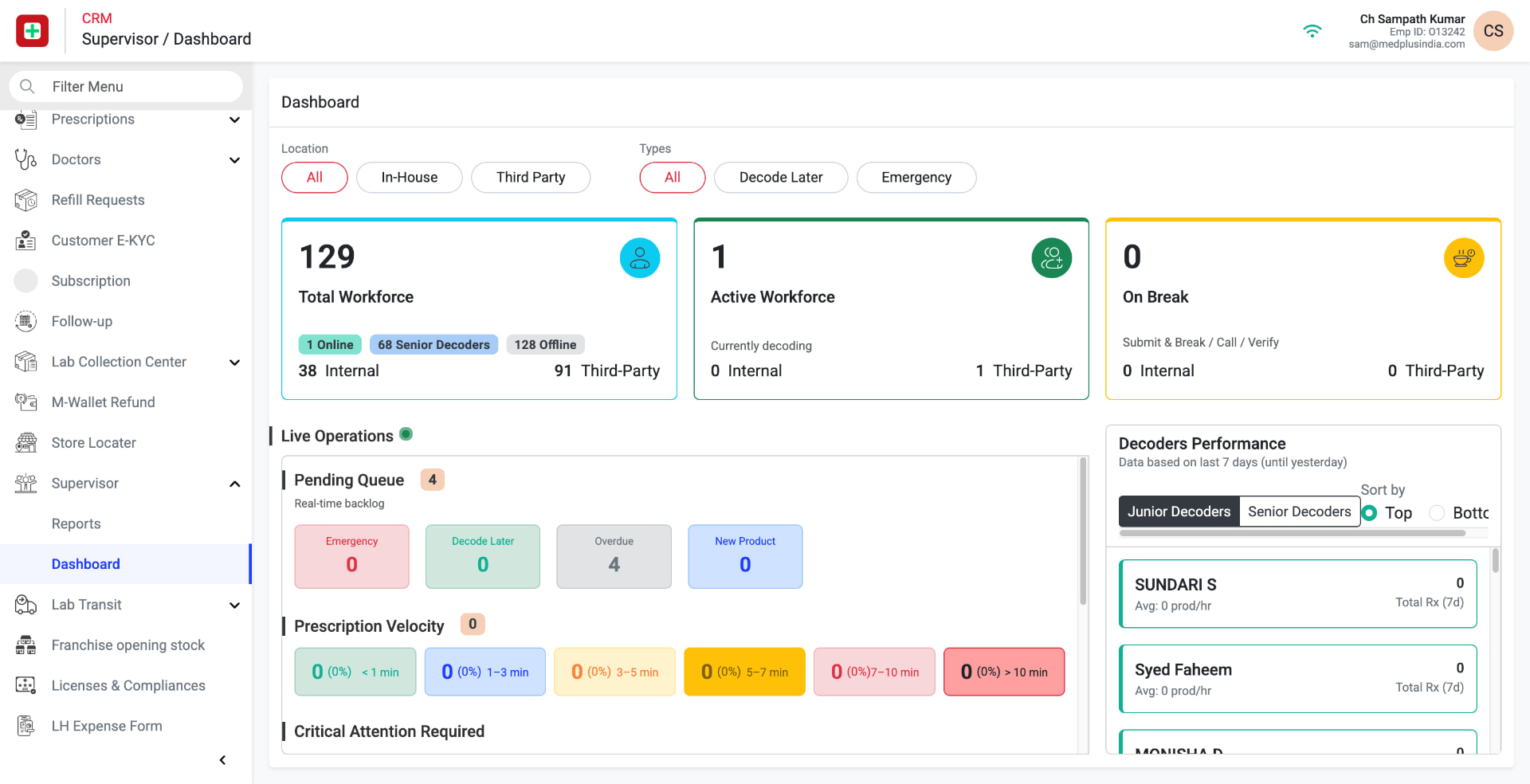
Supervisor dashboard with workforce totals, live operations, pending queue, prescription velocity, and decoder performance rankings

01 / 04 · Supervisor dashboard with workforce totals, live operations, pending queue, prescription velocity, and decoder performance rankings

02

The Challenge

Leading the cross-platform UX framework for deciphering highly volatile, handwritten medical scripts and complex Latin dosage abbreviations under tight checkout timelines.

Misreading a drug name introduces catastrophic medical compliance liabilities, while manual data entry stalls retail counters and creates high abandonment rates online.

The application required balancing rapid computer-vision extraction speed with a fail-safe, human-in-the-loop fallback mechanism that prevents checkout drops without sacrificing medical accuracy.

03

Problem Statement

Handwriting Data Entry Bottlenecks: Deciphering illegible doctor script manually stretches transaction processing times, frustrating on-site shoppers and online users alike.

Accuracy vs. Friction Trade-Off: High digital cart abandonment rates occur when automated software completely rejects a blurry script upload, forcing patients to start their search from scratch.

Compliance & Dispensing Vulnerabilities: Relying exclusively on manual pharmacist interpretation during high-volume peak rush hours elevates the baseline risk of medical dispensing errors.

04

Competitor Analysis

Competitors Assessed: Tata 1mg AI Upload, Apollo Digital Script Scan, legacy hospital backend OCR tools.

Gaps & opportunity

  • Strategic Gaps Identified: Competitor tools operate on a binary pass/fail architecture; if their AI cannot read a word, the app crashes out or tells the user to wait 2 to 4 hours for manual review.
  • No platform offers an atomic, real-time fallback pipeline that sends only the unread snippets to a live triage desk, allowing the rest of the recognisable items to be staged instantly for a fast checkout.

05

User Research

  • MethodologyEvaluated quantitative drop-off data by auditing 5,000 historical failed prescription uploads, shadowed retail pharmacists during evening peak crowds, and conducted 30 exit interviews with digital shoppers.
  • Insights DiscoveredOver 50% of prescription uploads fail due to localised paper wrinkles or bad lighting, even though 3 out of 4 listed medications are perfectly legible. Online users abandon checkout within 90 seconds if an app blocks their progression with a vague unreadable image error banner. Pharmacists report severe cognitive fatigue when interpreting non-standard medication shorthand while managed under tight customer service level queues.

Research was conducted before any design work; findings shaped the problem definition and strategy.

06

Discovery

Technical data discovery revealed that trying to achieve 100% pure AI extraction on terrible doctor handwriting is an engineering bottleneck with diminishing returns. I drove an operational UX architecture discovery: by splitting the upload image into discrete, line-by-line bounding box coordinates, our system can successfully process the 80% it understands instantly, while generating an isolated, real-time ticket containing only the corrupted crop snippet for our internal manual decoding desk to process under a 60-second operational SLA.

01

Contextual interviews

Shadowed retail pharmacists during evening peak crowds and observed how handwriting ambiguity, lighting, and queue pressure affected decoding decisions.

02

Journey mapping

Mapped the prescription upload journey from camera capture through cart population, pinpointing where hard rejections forced users to restart their order.

03

Analytics review

Audited 5,000 failed prescription uploads to quantify how many partial recognitions were being discarded and how many were recoverable through snippet-level triage.

07

Strategy

  1. Problem

    Traditional healthcare OCR systems completely block the order funnel when encountering an illegible handwritten word, wiping out digital and retail conversion metrics.

  2. Insight

    You don't need a perfect AI model to clear a checkout bottleneck; you need an intelligent routing model that pairs fast automation with real-time human triage support.

  3. Opportunity

    Dominate the omnichannel prescription fulfilment space by creating a continuous-checkout engine that never rejects an uploaded script.

  4. Strategy

    Deploy an asynchronous, micro-segmented vision parsing architecture backed by real-time human-in-the-loop dashboard triggers.

  5. Solution

    Launch the AI Decoder Engine featuring multi-line image fragmentation, an internal live-triage dashboard, and automated WhatsApp/SMS customer confirmation modules.

  6. Roadmap Prioritisation

    Phase 1 engineered the core OCR/NLP ingestion models and offline/online app embedding hooks. Phase 2 deployed the atomic snippet-splitting logic and the internal Manual Decoder agent screens. Phase 3 integrated the downstream automated customer confirmation and cart-injection hooks.

08

Design Process

Designed a dual-facing interface workflow. The customer interface (online/kiosk) features a minimal camera capture frame with dynamic real-time alignment grids and exposure auto-correction to ensure clean image inputs. The internal Manual Decoder agent workspace presents a high-density, dark-mode terminal layout displaying the isolated illegible snippet magnified side-by-side with an active, auto-suggestive pharmaceutical generic drug dictionary, minimising keystroke overhead for the triage operator.

01

Wireframes

Low-fidelity flows mapped the camera capture frame, real-time alignment grid, snippet-level fallback state, and internal decoder agent workspace.

02

Exploration

Explored minimal customer capture interfaces versus high-density dark-mode agent terminals, balancing frictionless upload with rapid triage keystroke efficiency.

03

Prototypes

Interactive prototypes connected the customer upload flow, bounding-box fragmentation, internal triage queue, and automated WhatsApp/SMS confirmation loops.

04

Testing

Tested with digital shoppers under poor lighting and with triage agents during peak volumes to validate capture clarity, snippet accuracy, and SLA compliance.

05

Final Design

A dual-facing experience: a minimal, guided capture UI for customers and a dark-mode, auto-suggestive triage terminal for internal decoding agents.

Only the iterations that changed the direction of the work are shown — not every exploration.

09

Final Experience

Final experience visuals for AI-Powered Prescription Decoder Platform Engine

10

Personas

Persona 01

Portrait of Devika Nair, a research persona

Devika Nair

The Stressed Digital Purchaser · Pharmacist

A busy working professional managing chronic prescription refills via smartphone apps for her household.

Goals

  • Upload a photo of a doctor's slip, have the items instantly populated into her online shopping cart, and check out without running into manual search filters.

Frustrations

  • Encountering processing delays or app rejections due to her doctor's rushed, messy handwriting style.
  • Age: 31
  • Married
  • Hyderabad, Telangana
  • Archetype: The Medicine Dispensor

Persona 02

Portrait of Sandeep Joshi, a research persona

Sandeep Joshi

The High-Velocity Triage Agent · Manual Decoding Operations Specialist

A backend operations agent sitting at a multi-monitor desk, tasked with identifying and correcting undecoded prescription text fragments pushed from stores and web apps.

Goals

  • Identify incoming medication snippets under tight SLAs, correct line errors using smart search lookups, and clear their queue cleanly.

Frustrations

  • System lag during high-volume peak evening hours and dealing with highly distorted or cut-off prescription images.
  • Age: 26
  • Single
  • Hyderabad, Telangana
  • Archetype: The Precision Keyboardist

11

Impact

-82%

Reduction in average end-to-end prescription checkout processing times

+34%

Uplift in digital cart checkout conversion rates

99.98%

Order accuracy via AI parsing and human validation layers

<45s

Average turnaround time for manual decoding desk resolution